
Eyelid
Eyelid Spacer Grafts (TarSys & Alternatives)
A spacer graft (TarSys and alternatives) rebuilds the vertical height of a retracted lower eyelid, correcting scleral show from thyroid eye disease, prior blepharoplasty, or trauma.
Medically reviewed by Tamara R. Fountain, MDOculoplastic SurgeonLast updated June 2026
Eyelid Spacer Grafts (TarSys & Alternatives)
An eyelid spacer graft is a small implant placed inside the eyelid to lengthen it vertically and lift a retracted lower lid back to its normal position. It is the workhorse repair for lower-eyelid retraction — most often from thyroid eye disease, but also after aggressive cosmetic lower blepharoplasty or trauma. TarSys® is one widely used processed-tissue spacer; several other graft materials do the same job.
This is a focused companion to our Thyroid Eye Disease guide, where eyelid surgery is the final step of rehabilitation after the orbit has stabilized.
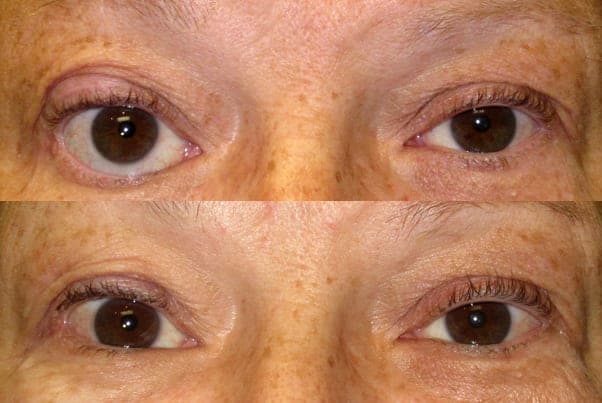
The Problem: Lower-Eyelid Retraction
A normal lower eyelid rests right at the lower edge of the colored part of the eye. When the lid is pulled downward — "retracted" — white sclera shows below the iris (scleral show), the eye looks startled, and the exposed surface dries and becomes irritated. In thyroid eye disease, inflammation and scarring of the lid retractor muscles shorten the back layer of the lid; after lower blepharoplasty, removing too much skin or scarring of the middle layer can tether the lid down.
The eyelid is built in layers — a front skin-muscle layer and a back layer (the tarsus and conjunctiva). When the back layer is too short, simply tightening the lid is not enough; the vertical height has to be rebuilt. That is what a spacer graft does: it is inserted into the back layer to add height and push the lid margin up.
Spacer Graft Options
A spacer can be the patient's own tissue (an autograft) or a processed graft material:
- Processed dermal / scleral spacers (e.g. TarSys®) — ready-to-use, off-the-shelf tissue that avoids a second surgical site; convenient and reliable for moderate retraction
- Hard-palate mucosal graft — taken from the roof of the mouth; a sturdy autograft that provides its own mucosal lining, favored for larger corrections
- Ear cartilage or autologous tissue — used when extra rigidity is needed
The choice depends on how much lift is required, whether a mucosal surface is needed against the eye, and surgeon preference. Processed spacers like TarSys avoid harvesting the patient's own tissue; palate and cartilage grafts add strength for the most retracted lids.
How the Repair Works
Through an incision on the inside of the lower lid, the surgeon releases the scarred, shortened back layer, then inserts the spacer graft to bridge the gap and add vertical height. The lid margin rises to cover the eye properly. A lid-tightening step (a canthal procedure) is often added to support the new position. In thyroid eye disease, this eyelid step comes last — after any orbital decompression and eye-muscle (strabismus) surgery — because those earlier operations change lid position, and operating on a still-active, inflamed orbit invites relapse.
Recovery and Results
Swelling and bruising settle over one to two weeks, with the graft integrating over the following months. Most patients notice early improvement in scleral show once swelling subsides and in the dryness and irritation that come from an exposed eye surface. Because the repair rebuilds the lid's structural height, results are typically long-lasting, though grafts can contract somewhat as they heal — surgeons often slightly overcorrect to allow for this, and occasionally a revision or touch-up is needed. As with any graft procedure, uncommon risks include infection, graft exposure or extrusion, granuloma formation, and under- or overcorrection; autografts (palate or ear cartilage) also involve temporary discomfort at the donor site.
When to See a Specialist
Lower-lid retraction with a dry, exposed, or irritated eye — whether from thyroid eye disease or after previous eyelid surgery — should be evaluated by an oculoplastic surgeon experienced in reconstructive eyelid work. An ASOPRS-trained oculoplastic surgeon can determine which spacer approach best restores your eyelid position and protects the eye.
Retracted lower eyelid or scleral show after surgery?
Spacer-graft reconstruction restores eyelid height and comfort. Find an ASOPRS-trained oculoplastic surgeon near you.
Ready to discuss Eyelid Spacer Grafts (TarSys & Alternatives)?
Schedule a consultation with Tamara R. Fountain, MD to learn if this procedure is right for you.